
Commercial development in Cherokee County runs through a digital plan review process that brings together county engineering, stormwater, zoning, transportation, fire and building review, plus separate water, sewer and health department approvals. Projects that move quickly tend to be the ones that pick the right permit, submit a coordinated set the first time and treat the outside reviews as part of the critical path.
This guide covers the land disturbance permit for commercial projects in unincorporated Cherokee County: when it applies, who reviews, how submittals work and what the county's stormwater checklist asks for. It is a planning guide, not a substitute for the county's current application and comments.
1. Confirm the parcel is in unincorporated Cherokee County
A Canton or Woodstock mailing address does not tell you who has jurisdiction. Cherokee County contains the cities of Ball Ground, Canton, Holly Springs, Waleska and Woodstock, plus portions of Mountain Park and Nelson. A parcel inside a city follows that city's zoning and development process. Check the parcel against current county and city GIS before scoping the civil work.
2. LDP or erosion control permit?
In unincorporated Cherokee County, a Land Disturbance Permit (LDP) covers clearing and grading of land of one acre or more, tree or vegetation removal, excavation and filling, debris deposition, and any disturbance of soil within 200 feet of state waters. Clearing and grading of less than one acre is regulated by an Erosion Control Permit instead.
The 200-foot rule catches people. A small outparcel near a creek can still need a full LDP. Locate streams and other state waters on the survey before deciding which permit you are applying for.
3. Know who reviews the plans
The county lists internal reviews by the Building Department, Development Inspection, Engineering, Planning and Zoning, Stormwater, Transportation and the county Arborist for tree preservation. External reviews come from the Office of Environmental Health, the Fire Marshal and the Cherokee County Water and Sewer Authority (CCWSA).
The county portal upload is for county reviewers only. Water, sewer and environmental health reviews are handled directly with those agencies, so they need their own submittal, their own comment tracking and a place on the schedule. If the project will use septic, Environmental Health approval is required before county approval.
4. Submit digitally, and answer every comment
Plans are submitted through the county's CityView portal after registering an account; paper plans are not accepted. Each resubmittal must include an annotated document showing where each comment was addressed. After a second failed submittal, the county asks the applicant to schedule a meeting with the development team, typically on a Thursday afternoon.
The county also publishes a Plan Approval Customer Guide, a "Commonly Missed Items for Plan Review" presentation and a "Recurring Site Plan Comments" checklist. Read the last two before the first submittal. They are the cheapest way to avoid a third review cycle.
5. Plan for Cherokee's stormwater checklist
Cherokee's stormwater plan review checklist is detailed, and several items routinely shape a commercial layout. In the version we reviewed:
- A hydrology report is required for new development creating 5,000 square feet or more of impervious cover, or other land development of 1.0 acre or more, and it must be sealed by a Georgia professional engineer.
- Post-developed peak flow may not exceed pre-developed peak flow for the 2, 5, 10, 25 and 100-year storms.
- Water quality must achieve 80% site-wide TSS removal, with runoff reduction met to the extent feasible, documented in the regional site review spreadsheet.
- A downstream analysis is required, and undersized downstream pipes or channels may have to be upsized.
- Ponds may not sit in a stream or zoning buffer, embankments can be no steeper than 2:1, and ponds with slopes steeper than 3:1 and 100-year depths over 4 feet need a fence with a 10-foot gate.
- A 12-foot access route and easement from a public street to the facility, and pond retaining wall structural design before the LDP is issued.
- Proprietary water quality devices are allowed with third-party testing data, but not in the right-of-way of county roads.
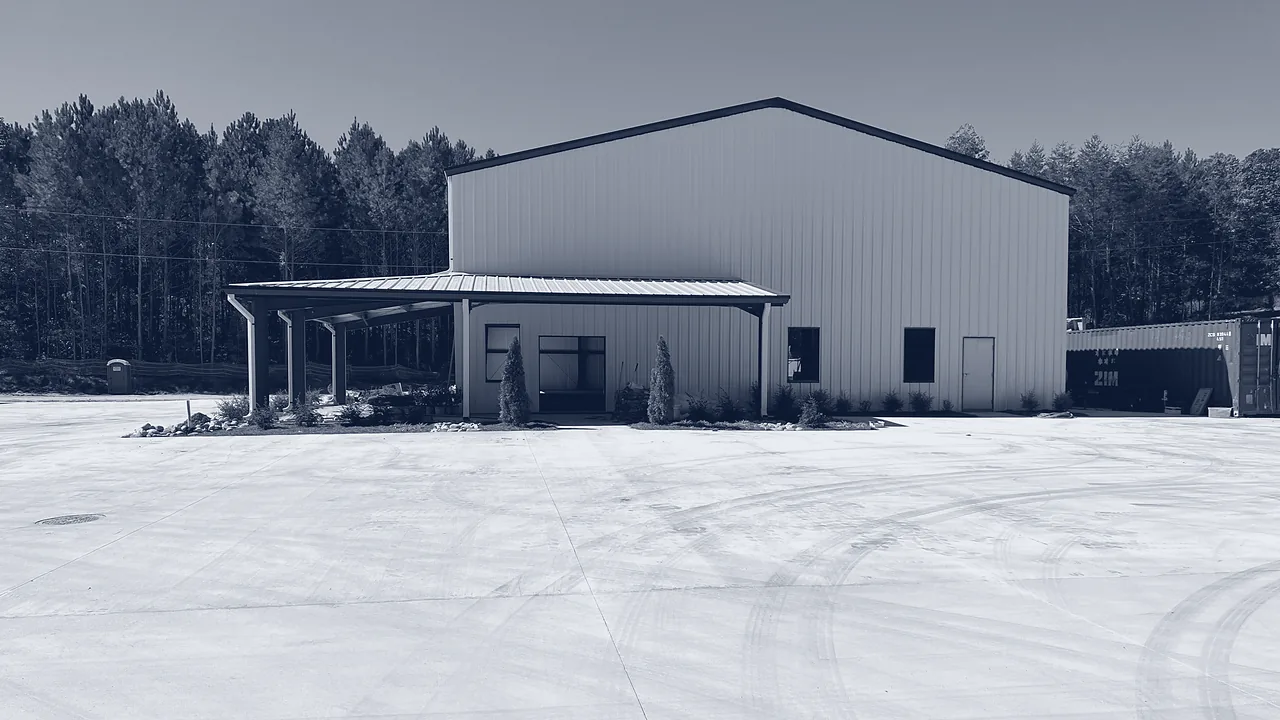
Those requirements take land. On constrained commercial sites, an underground system is often the way to keep the building pad and parking intact. The A1 Contractors offices that MASS designed in Ball Ground used an underground stormwater management system alongside stream buffers and temporary erosion controls.
6. Access, frontage and utilities
Confirm whether the frontage is a county road or a state route. Georgia DOT handles driveway and right-of-way permits on state routes separately from county review. On county roads, the review can bring frontage improvements and turn lanes into the scope. The A1 Contractors project included a new roadway with a deceleration lane, a force main and water connections, and fire, power and gas service to every new building. Each of those is a separate coordination thread with its own owner.
For water and sewer, confirm availability, capacity and connection points with CCWSA early. A sewer force main or off-site extension can become the longest item on the schedule.
7. Keep zoning ahead of the civil design
The county's engineering staff also review rezoning and variance applications. If the use, setbacks, buffers or parking need a zoning action, resolve it before the civil set is finalized. Otherwise the layout, stormwater design and utility routing may need to be redone after the hearing.
Cherokee County commercial LDP checklist
- Jurisdiction confirmed as unincorporated Cherokee County, not a city.
- State waters located; 200-foot LDP trigger and stream buffers checked.
- LDP or Erosion Control Permit selected correctly.
- Zoning, conditions and any variance needs resolved.
- CityView account registered and current county checklists downloaded.
- Commonly Missed Items and Recurring Site Plan Comments reviewed.
- PE-sealed hydrology report with pre and post analysis for the 2 through 100-year storms.
- Water quality spreadsheet, runoff reduction and downstream analysis complete.
- Pond or underground system details, access and easements shown.
- CCWSA, Environmental Health and Fire Marshal submittals started in parallel.
- Road owner and access improvements confirmed.
- Comment-response document prepared for every resubmittal.
Frequently asked questions
Do I need an LDP for a site under one acre?
Usually an Erosion Control Permit covers clearing and grading under one acre. But the county requires an LDP for any soil disturbance within 200 feet of state waters, so a small site near a stream can still need one.
How long does Cherokee County LDP review take?
The county does not publish a standard duration on its permit page. Timing depends on plan completeness, the number of comment cycles and the separate water, sewer, health and fire reviews. A complete, coordinated first submittal is the biggest factor you control.
Can I submit paper plans?
No. The county states it does not accept paper plans. Submittals go through the CityView portal.
Verified against Cherokee County's published permit page and stormwater checklist in October 2026. Checklists, departments and procedures change. Confirm current requirements for the exact parcel before submitting plans or disturbing land.