
On most commercial sites in metro Atlanta and North Georgia, stormwater is the design element most likely to move the building, cost parking spaces or trigger off-site work. It is also the one most often left until after the layout feels finished. That order is backwards. Detention, water quality and the downstream outfall need room, and the amount of room depends on rules that vary by jurisdiction.
This guide explains where Georgia's post-construction stormwater requirements come from, what a commercial site is typically designed to, where local rules go further, and how to keep stormwater from surprising the pro forma.
Where Georgia's stormwater requirements come from
The technical basis is the Georgia Stormwater Management Manual (GSMM), 2016 edition. Volume 1 is a guide for local governments and Volume 2 is the Technical Handbook designers use to size and detail stormwater practices. In the Metro North Georgia Water Planning District, local governments adopt a post-construction stormwater ordinance based on the District's model ordinance. Jurisdictions may customize that ordinance and may be more stringent than the model, so the manual sets the floor and the local ordinance and checklist set the actual requirement.
Practically, that means the right question is never just "what does the GSMM say?" It is "what has this city or county adopted, and what does its plan reviewer ask for?"
When a commercial project triggers stormwater review
Thresholds are set locally. As one example, Cherokee County's stormwater plan review checklist states that a post-developed stormwater management plan and hydrology report are required for new development that creates 5,000 square feet or more of impervious cover, or that involves other land development of 1.0 acre or more. Many commercial pad sites cross that line easily.
Redevelopment is treated differently. Under the model ordinance, the existing-conditions hydrology for a redevelopment site may take the existing development into account, unless that development is causing a negative impact downstream. A former shopping-center parcel can therefore start from a different baseline than raw land, which is one reason redevelopment sites deserve an early hydrology check rather than an assumption.
The standards a commercial site is typically designed to
The model ordinance organizes the requirements into a set of standards. Your civil engineer will test the site against each one:
- Runoff reduction: retain the first 1.0 inch of rainfall on site using runoff reduction methods, to the maximum extent practicable.
- Water quality: where runoff reduction is shown to be infeasible under the jurisdiction's practicability policy, remove at least 80% of the average annual post-development total suspended solids (TSS) load for runoff from a 1.2-inch rainfall event.
- Stream channel protection: commonly met with 24-hour extended detention of the 1-year, 24-hour storm, with limited exemptions described in the manual.
- Overbank flood protection: control of the post-development peak discharge for the 25-year, 24-hour storm.
- Extreme flood protection: management of the 100-year storm, either by controlling it or by safely passing it.
- Downstream analysis: a look past the property line to confirm the development does not create adverse impacts downstream.
Local rules frequently go further. Cherokee County's checklist, for instance, requires the hydrology report to show that post-developed peak flow does not exceed pre-developed peak flow for the 2, 5, 10, 25 and 100-year storms, and it notes that undersized downstream pipes or channels may have to be upsized based on the downstream analysis. Other jurisdictions add their own storms, methods or safety factors. Read the local checklist before the concept is fixed.
Detention pond or underground system?
A surface pond is usually the less expensive way to store a given volume, but it consumes land. Add side slopes, freeboard, a maintenance access route, easements and, in some jurisdictions, perimeter fencing, and the footprint grows quickly. Cherokee's checklist, for example, limits pond embankments to 2:1, requires a fence and gate around ponds with slopes steeper than 3:1 and 100-year ponding depths over 4 feet, and calls for a 12-foot access route from a public street.
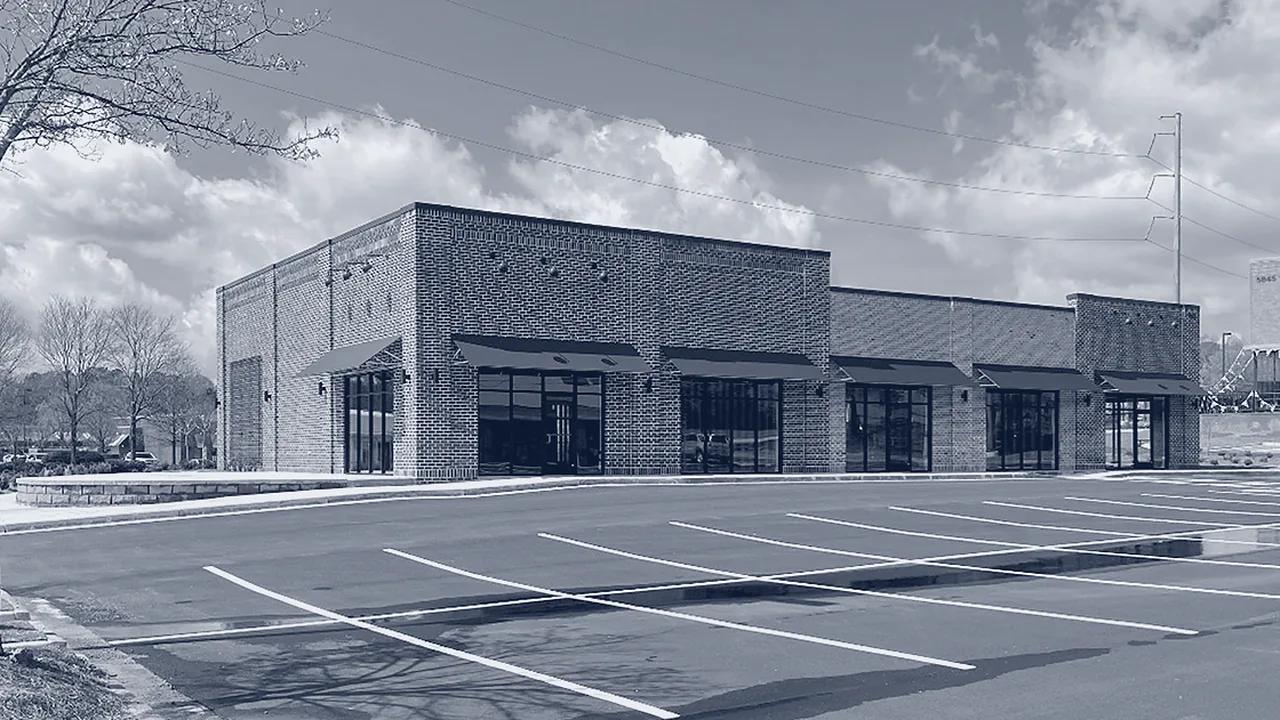
An underground system of pipes, chambers or vaults costs more to build but leaves the surface available for building pad and parking. On a tight infill or redevelopment site, that trade often decides whether the project works. At Red Top Brewhouse in downtown Acworth, a site hemmed in by adjacent development, MASS used a new underground stormwater management system so the site could carry the brewery building and its ancillary structures. The Johns Creek spec retail building took the same approach inside an existing shopping plaza, along with downstream assessments and permitting with multiple jurisdictions.
Underground storage still has to meet the water quality and runoff reduction standards, so it is often paired with treatment upstream, such as a proprietary device or other practices from the manual. Plan for access to inspect and clean whatever you install.
What the hydrology report and stormwater plan contain
The model ordinance lists the parts of a stormwater management plan: a natural resources inventory, the stormwater concept plan, existing-conditions and post-development hydrologic analyses, the stormwater management system design, the downstream analysis, the erosion and sedimentation control plan, a BMP landscaping plan, an inspection and maintenance agreement, evidence of other required permits, and a determination of infeasibility where runoff reduction cannot be met. The hydrologic analyses, system design and downstream analysis must be sealed by a professional engineer licensed in Georgia.
Maintenance agreements run with the land
Under the model ordinance, the owner signs an inspection and maintenance agreement with the local government, records it against every parcel in the site, and that obligation binds future owners. Buyers of existing centers should read the recorded agreement during due diligence. Developers splitting a site into outparcels should decide early who owns and maintains a shared facility, and write that into the cross-access and easement documents.
Stormwater planning checklist
- Confirm the governing jurisdiction and pull its current stormwater ordinance and plan review checklist.
- Determine whether the project is new development or redevelopment, and what baseline applies.
- Check impervious-area and disturbance thresholds that trigger a hydrology report.
- Identify the outfall, the downstream system and any known capacity problems.
- Test runoff reduction feasibility early, including soils information for infiltration practices.
- Size a preliminary detention volume and reserve space for it on the concept plan.
- Compare surface pond and underground storage on land value, construction cost and maintenance.
- Locate maintenance access routes and easements.
- Check for floodplain, stream buffers or state waters affecting the facility location.
- Review any existing recorded maintenance agreements or shared-facility obligations.
- Coordinate the stormwater design with the erosion control plan and grading.
- Carry the stormwater approach into the budget before closing.
Frequently asked questions
Does every commercial site need a detention pond?
No. Whether detention is required, and what form it takes, depends on the local thresholds, any exemptions the ordinance allows and the downstream conditions. Some sites use underground storage, and some qualify for exemptions. Even then, a jurisdiction may require a hydrology report that demonstrates the exemption, as Cherokee County's checklist does.
Can a new outparcel use the shopping center's existing pond?
Sometimes. It depends on whether the facility was designed and approved for the full build-out, whether it still performs as designed, and what the recorded agreements allow. Ask for the original hydrology report and as-built information, and have the engineer confirm capacity and water quality treatment before relying on it.
When should stormwater be evaluated?
During site due diligence, while the purchase price and layout can still change. A preliminary stormwater concept is inexpensive compared with discovering after closing that the facility needs a third of the usable land.
This article is general information based on the GSMM, the Metro North Georgia Water Planning District model ordinance and published local checklists as reviewed in October 2026. Adopted requirements change and differ by jurisdiction. Confirm the current rules for the exact parcel before relying on a design or budget decision.